November 10, 2025
Designing Human Flow
Urban UX Design
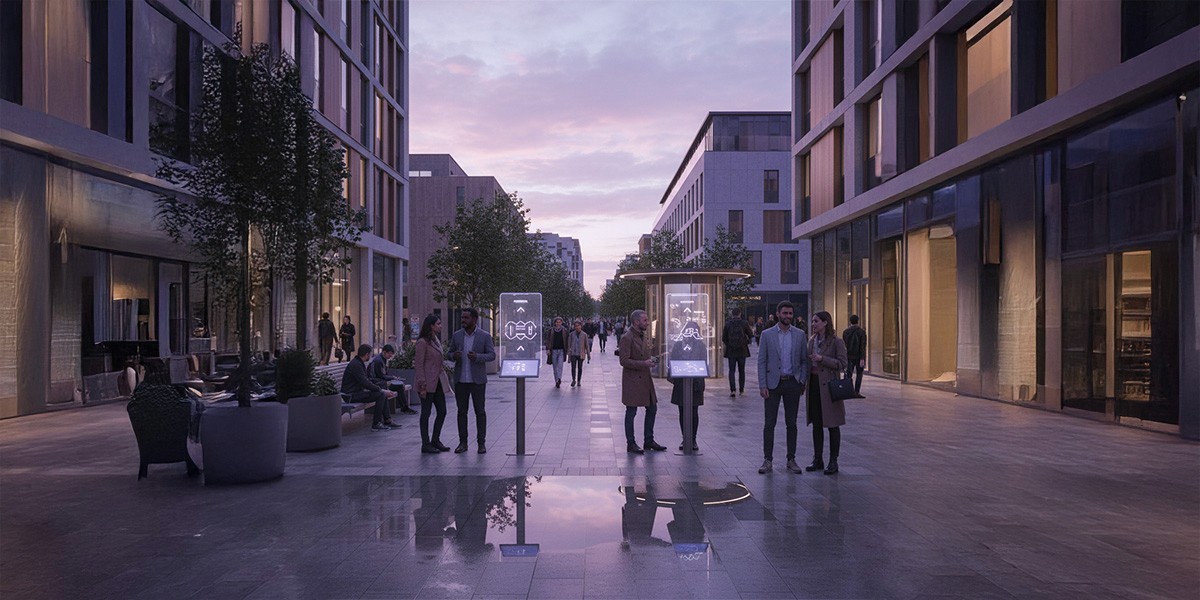
When we talk about design—whether digital, physical, or urban—we are ultimately talking about one thing: how humans experience the world. This shared foundation connects the logic of cities, the rhythm of walking, and the clarity of everyday objects. And it is precisely this intersection that shapes the future of UI/UX design.
Books like Cities for People, A Philosophy of Walking and The Design of Everyday Things may explore different subjects, but they converge on a powerful idea:
good design starts with understanding real human behavior.
This idea is also the core of Urban UX.
Human-Scaled Thinking → From City Streets to Digital Screens
Jan Gehl’s human-scale perspective reminds us that environments—digital or physical—only succeed when they feel approachable, legible, and empathetic.
A well-designed street and a well-designed interface share a simple truth:
People prefer clarity, comfort, and intuitive flow.
Urban UX borrows this mindset to shape apps, kiosks, maps, and digital public services that feel as natural as a pedestrian-friendly street.
Rhythm and Movement → Designing for Real Human Pace
Frédéric Gros’ reflections on walking teach us that humans move through the world with a certain rhythm—sometimes hurried, sometimes slow, but always embodied.
In UX, this becomes a design principle:
Interfaces must work while we’re moving.
Information must be digestible at a glance.
Services must respect attention, pace, and mental load.
A city app that works seamlessly during a commute is, in essence, an extension of the walking experience.
Clarity and Usability → Making Complexity Simple
Don Norman’s insights into everyday objects reveal that the things we use should guide us naturally.
This principle holds even more weight when designing for cities, where services are complex and used by diverse populations.
Urban UX transforms complexity into clarity:
simple flows
visible actions
meaningful feedback
easy error recovery
Just as a door should indicate how it opens, a city interface should indicate how to act.
The Human Experience as the Core of Urban UX
When we blend these perspectives, a unified message emerges:
Good design—urban or digital—honors the way people move, think, and sense the world.
Cities become interfaces.
Walking becomes interaction.
Everyday objects become lessons in usability.
Urban UX is the space where these ideas meet.
It aims to create technological systems that feel as intuitive as familiar streets, as natural as walking, and as understandable as the objects we use every day.
In other words:
Urban UX is designing technology that behaves like a city built for humans.
Our listening senses profoundly connect with our convictions, experiences, and sense of comfort.
Nonetheless, in modern times burdened with persistent noise and electronic interference, harnessing moments of peacefulness has transformed into a sought-after luxury. Arranged harmonies for tranquility instill focus, particularly when they are wordless, as lyrics might lead us toward mental activity instead of inducing tranquility.
MY RECENT STORIES
August 24, 2025
August 24, 2025
July 08, 2025
July 08, 2025